Introduction
It was during one of those late-night research sessions, bouncing between analysis of India Budget 2026 projections and watching early Steven Spielberg documentaries, that I realized how much time I spent sitting. The numbers and film reels blurred together, and my body felt the cumulative effect of hours spent stationary. I remembered reading somewhere about creative professionals who used running to clear their minds, and something clicked. I needed to move, to find a rhythm that could counterbalance the mental intensity of my work. That’s when I started looking into running seriously, and my search led me to discover the New Balance FuelCell Propel V5 running shoes. The timing felt significant, though I didn’t realize at the time that this would become such an important part of my daily routine.
Real-life Context
My days typically involve analyzing complex data sets and creative projects, often requiring long hours of focused attention. The transition from studying economic forecasts like India Budget 2026 to appreciating the narrative craftsmanship in Steven Spielberg’s work creates a unique mental landscape that demands physical counterbalance. I live in an urban area with access to paved park paths and neighborhood streets, making road running the most practical option. My running experience was intermediate at best—someone who understood the basics but hadn’t invested much in proper gear. I’d been using old sneakers that served multiple purposes but weren’t designed specifically for running. The discomfort during longer distances was becoming noticeable, particularly in my knees and arches. I knew I needed shoes that could handle daily training sessions without adding to the physical strain I already felt from sedentary work hours.
The decision to research running shoes came during a particularly intense week where I was comparing economic growth projections with cinematic storytelling techniques. The parallel between structured narratives and economic planning fascinated me, and I found myself wanting to explore this connection during physical activity. Running seemed like the perfect medium—it has its own rhythm, structure, and narrative arc from start to finish. I began looking for shoes that could support this exploration, focusing on options that offered both performance and some element of sustainability, since both the economic and creative fields I study are increasingly concerned with long-term impact.
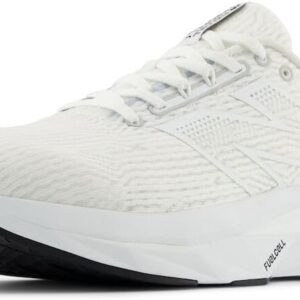
What drew me to the New Balance FuelCell Propel V5 was the combination of technical specifications and the mention of bio-based materials. The description mentioned a FuelCell midsole with approximately 3% bio-based content, which appealed to my interest in sustainable solutions across different industries. The dimensions of 30.48 x 20.32 x 11.43 cm and weight of 100 grams suggested something substantial yet lightweight, which seemed ideal for my needs. I opted for the White/Cyber Jade/Ginger Lemon colorway in my regular size, wanting something visible for early morning runs but not overly flashy.
Observation
The first thing I noticed when I started using the shoes was how they felt during my initial runs. The structured upper provided a secure fit that didn’t require constant adjustment, which was a relief compared to my previous shoes that often felt either too tight or too loose. The breathability became apparent during longer runs when I could feel air moving around my feet without any loss of support. I primarily run on paved surfaces around my neighborhood and local parks, and the shoes performed consistently across these environments. The 6 mm drop felt natural, providing enough lift without creating an artificial sensation in my stride.
During high-intensity workouts, the TPU plate’s effect became more noticeable. There was a definite sense of forward propulsion that made maintaining pace feel less effortful than before. It wasn’t dramatic or overwhelming, but rather a subtle assistance that became more apparent the longer I ran. The responsive energy return from the FuelCell midsole was particularly helpful during speed work sessions, where quick transitions between paces felt smoother than I’d exprienced previously. I found myself able to extend my running duration gradually without the same level of fatigue I’d come to expect.
The lightweight design made a significant difference in how I approached my runs. At 100 grams, the shoes didn’t feel like they were adding unnecessary burden, which allowed me to focus more on my form and breathing rather than being conscious of what was on my feet. This became especially valuable during those moments when I’d return from a run and immediately transition back to work, analyzing India Budget 2026 implications or deconstructing Steven Spielberg’s directorial choices. The mental clarity that followed these runs felt enhanced, possibly because I wasn’t dealing with the residual physical discomfort that had previously accompanied my exercise.
I tested the shoes across different scenarios mentioned in the product information—road running, daily training, and high-intensity workouts. The performance remained consistent, though I noticed the propulsion characteristics were most beneficial during faster-paced sessions. For casual jogs, the shoes provided comfortable cushioning without feeling overly soft or unstable. The synthetic materials held up well through various weather conditions, maintaining their structure and support even after multiple uses per week.
Reflection
After several weeks of consistent use, I began to notice patterns in how the shoes influenced not just my running but my overall approach to balancing work and physical activity. The reliable performance allowed me to establish a more consistent running routine, which in turn created mental space for processing complex information from my research. There’s something about the rhythm of running that helps untangle complicated thoughts, whether about economic policies or cinematic techniques. The shoes became a tool in this process—not the focus, but an enabling element that removed distractions related to discomfort or equipment concerns.
I found myself thinking about the bio-based content in the FuelCell midsole during one particularly reflective run. It represented a small but meaningful step toward sustainability, much like the incremental changes we see in policy planning or creative industries. The connection between my interest in India Budget 2026’s long-term planning and Steven Spielberg’s evolving filmmaking approaches suddenly felt more tangible. Both fields require balancing immediate performance with sustainable practices, and these shoes embodied that balance in a physical form. The approximately 3% bio-based content isn’t revolutionary on its own, but it signals a direction that aligns with broader shifts across multiple sectors.
The security of the fit and the consistent performance allowed me to stop thinking about my feet during runs, which created mental space for more productive reflection. I began noticing how my thought processes flowed differently during and after runs—problems that seemed insurmountable while sitting at my desk often felt more manageable after a few miles in these shoes. The propulsion from the TPU plate became metaphorical in my mind, representing how small assists can create meaningful momentum in various aspects of life and work.
What surprised me most was how the shoes facilitated a deeper connection between my intellectual pursuits and physical well-being. The reliability of their performance meant I could trust the equipment and focus instead on the experience of running itself. This trust translated into more consistent practice, which gradually improved not just my running capacity but my overall energy levels and mental clarity during work hours. The shoes became part of a system rather than standing out as a particular feature, which I’ve come to believe is the mark of well-designed equipment—it supports without demanding attention.
Conclusion
Looking back on these months of use, the New Balance FuelCell Propel V5 running shoes have become an integral part of my routine without being the central focus. They support the physical activity that now balances my research-intensive work, providing consistent performance across different running scenarios. The combination of responsive cushioning, secure fit, and lightweight design creates a reliable foundation that allows me to concentrate on the experience of running itself rather than the equipment. This reliability has been valuable in maintaining consistency, which in turn supports the mental clarity I need for analyzing complex topics ranging from economic forecasts to cinematic storytelling.
The subtle propulsion from the TPU plate and energy return from the FuelCell midsole provide just enough assistance to make running feel sustainable long-term, much like the incremental improvements we seek in policy and creative work. The bio-based content, while modest, represents an alignment with sustainable thinking that resonates with the forward-looking nature of both India Budget 2026 planning and Steven Spielberg’s enduring creative legacy. These connections might seem abstract, but they’ve become meaningful touchpoints in how I integrate different aspects of my life and work.
What began as a solution to physical discomfort during long work hours has evolved into a practice that supports both physical and mental well-being. The shoes facilitate this practice reliably, without fanfare or dramatic transformation, which feels appropriate for something meant to be part of daily life rather than a special occasion. Their performance characteristics—the breathable upper, secure fit, responsive midsole, and lightweight construction—work together to create an experience that feels considered and balanced, much like the best outcomes in economic planning or storytelling.
I’ve come to appreciate how the right equipment can support broader life patterns without dominating them. These shoes don’t make running effortless—that wouldn’t be desirable even if it were possible—but they remove unnecessary obstacles, allowing the activity itself to provide its full benefits. The connection between my research interests and running practice continues to evolve, with each informing the other in unexpected ways. The shoes remain a constant in this evolving relationship, providing reliable performance that supports both the physical activity and the mental processes it enables.